Wednesday, June 25, 2008
World Trade Center site
Found this site while doing research for my paper, thought it was pretty interesting because it gives a lot of pictures of what Ground Zero looks like right now, and what it will look like later after the memorial is all built with the Freedom Tower. There is also a lot of facts about all the construction that will be taking place.


Tuesday, June 24, 2008
Putting the finishing touches on my paper, and still doing some extra research. I found some interesting stuff. First off:
http://blog.washingtonpost.com/channel-08/2007/11/question_23_does_rudy_giuliani.html
I couldnt believe this, its the Family Guy clip i posted a while back, spliced with clips from the republican debate. really funny.
Also, when the other group brought in Cloverfield, i was disturbed by the cover art for the DVD, because it reminded me sooooo much of a picture I took at the Statue of Liberty yeeeears ago. I went searching for that pic, but couldn't find it :( Still I find this interesting tho, kinda creepy too..


http://blog.washingtonpost.com/channel-08/2007/11/question_23_does_rudy_giuliani.html
I couldnt believe this, its the Family Guy clip i posted a while back, spliced with clips from the republican debate. really funny.
Also, when the other group brought in Cloverfield, i was disturbed by the cover art for the DVD, because it reminded me sooooo much of a picture I took at the Statue of Liberty yeeeears ago. I went searching for that pic, but couldn't find it :( Still I find this interesting tho, kinda creepy too..


Monday, June 23, 2008
response
I just saw the link that the professor sent us, and it makes me wonder that if everything is revealed about the decisions our president makes then how can things be safe. To what extent should private things be made public? Is revealing everything about our decision making make us weak to the outside world in the long run?
Monday, June 16, 2008
Cheney v. U.S. District Court
"The case Cheney vs. U.S. District Court is scheduled to be heard before the Supreme Court next month and could end up revealing more about the Bush administration's motives for the 2003 Iraq war than any conceivable investigation of U.S. intelligence concerning Iraq's purported weapons of mass destruction...."
More links on the court case:
High court hears Cheney case(MSNBC)
Dick Cheney: The (Supreme Court Nominee) Decider (Wall Street Journal blog)
Supreme Court accepts Cheney appeal on energy taskforce (CNN)
Taking on the Supreme Court Case (Washington Post)
More links on the court case:
High court hears Cheney case(MSNBC)
Dick Cheney: The (Supreme Court Nominee) Decider (Wall Street Journal blog)
Supreme Court accepts Cheney appeal on energy taskforce (CNN)
Taking on the Supreme Court Case (Washington Post)
9/11 Memorial Cobblestone
Click here to read the press update about the campaign to purchase cobblestones as gifts.
Thursday, June 12, 2008
Wednesday, June 11, 2008
Fifty-nine Deceits in Fahrenheit 9/11 by Dave Kopel
Just a little something to further fuel our confusion over facts in the media.
Two Months Before 9/11, an Urgent Warning to Rice
Sunday, October 1, 2006; Page A17
On July 10, 2001, two months before the attacks on the World Trade Center and the Pentagon, then-CIA Director George J. Tenet met with his counterterrorism chief, J. Cofer Black, at CIA headquarters to review the latest on Osama bin Laden and his al-Qaeda terrorist organization. Black laid out the case, consisting of communications intercepts and other top-secret intelligence showing the increasing likelihood that al-Qaeda would soon attack the United States. It was a mass of fragments and dots that nonetheless made a compelling case, so compelling to Tenet that he decided he and Black should go to the White House immediately.
Tenet called Condoleezza Rice, then national security adviser, from the car and said he needed to see her right away. There was no practical way she could refuse such a request from the CIA director.
For months, Tenet had been pressing Rice to set a clear counterterrorism policy, including specific presidential orders called "findings" that would give the CIA stronger authority to conduct covert action against bin Laden. Perhaps a dramatic appearance -- Black called it an "out of cycle" session, beyond Tenet's regular weekly meeting with Rice -- would get her attention.
Tenet had been losing sleep over the recent intelligence he'd seen. There was no conclusive, smoking-gun intelligence, but there was such a huge volume of data that an intelligence officer's instinct strongly suggested that something was coming. He and Black hoped to convey the depth of their anxiety and get Rice to kick-start the government into immediate action.
He did not know when, where or how, but Tenet felt there was too much noise in the intelligence systems. Two weeks earlier, he had told Richard A. Clarke, the National Security Council's counterterrorism director: "It's my sixth sense, but I feel it coming. This is going to be the big one."
But Tenet had been having difficulty getting traction on an immediate bin Laden action plan, in part because Defense Secretary Donald H. Rumsfeld had questioned all the National Security Agency intercepts and other intelligence. Could all this be a grand deception? Rumsfeld had asked. Perhaps it was a plan to measure U.S. reactions and defenses.
Tenet had the NSA review all the intercepts, and the agency concluded they were of genuine al-Qaeda communications. On June 30, a top-secret senior executive intelligence brief contained an article headlined "Bin Laden Threats Are Real."
Tenet hoped his abrupt request for an immediate meeting would shake Rice. He and Black, a veteran covert operator, had two main points when they met with her. First, al-Qaeda was going to attack American interests, possibly in the United States itself. Black emphasized that this amounted to a strategic warning, meaning the problem was so serious that it required an overall plan and strategy. Second, this was a major foreign policy problem that needed to be addressed immediately. They needed to take action that moment -- covert, military, whatever -- to thwart bin Laden.
The United States had human and technical sources, and all the intelligence was consistent, the two men told Rice. Black acknowledged that some of it was uncertain "voodoo" but said it was often this voodoo that was the best indicator.
Tenet and Black felt they were not getting through to Rice. She was polite, but they felt the brush-off. President Bush had said he didn't want to swat at flies.
As they all knew, a coherent plan for covert action against bin Laden was in the pipeline, but it would take some time. In recent closed-door meetings the entire National Security Council apparatus had been considering action against bin Laden, including using a new secret weapon: the Predator unmanned aerial vehicle, or drone, that could fire Hellfire missiles to kill him or his lieutenants. It looked like a possible solution, but there was a raging debate between the CIA and the Pentagon about who would pay for it and who would have authority to shoot.
Besides, Rice seemed focused on other administration priorities, especially the ballistic missile defense system that Bush had campaigned on. She was in a different place.
Tenet left the meeting feeling frustrated. Though Rice had given them a fair hearing, no immediate action meant great risk. Black felt the decision to just keep planning was a sustained policy failure. Rice and the Bush team had been in hibernation too long. "Adults should not have a system like this," he said later.
The July 10 meeting between Tenet, Black and Rice went unmentioned in the various reports of investigations into the Sept. 11 attacks, but it stood out in the minds of Tenet and Black as the starkest warning they had given the White House on bin Laden and al-Qaeda. Though the investigators had access to all the paperwork on the meeting, Black felt there were things the commissions wanted to know about and things they didn't want to know about.
Philip D. Zelikow, the aggressive executive director of the Sept. 11 commission and a University of Virginia professor who had co-authored a book with Rice on Germany, knew something about the July 10 meeting, but it was not clear to him what immediate action really would have meant. In 2005 Rice hired Zelikow as a top aide at the State Department.
Afterward, Tenet looked back on the meeting with Rice as a tremendous lost opportunity to prevent or disrupt the Sept. 11 attacks. Rice could have gotten through to Bush on the threat, but she just didn't get it in time, Tenet thought. He felt that he had done his job and had been very direct about the threat, but that Rice had not moved quickly. He felt she was not organized and did not push people, as he tried to do at the CIA.
Black later said, "The only thing we didn't do was pull the trigger to the gun we were holding to her head."
On July 10, 2001, two months before the attacks on the World Trade Center and the Pentagon, then-CIA Director George J. Tenet met with his counterterrorism chief, J. Cofer Black, at CIA headquarters to review the latest on Osama bin Laden and his al-Qaeda terrorist organization. Black laid out the case, consisting of communications intercepts and other top-secret intelligence showing the increasing likelihood that al-Qaeda would soon attack the United States. It was a mass of fragments and dots that nonetheless made a compelling case, so compelling to Tenet that he decided he and Black should go to the White House immediately.
Tenet called Condoleezza Rice, then national security adviser, from the car and said he needed to see her right away. There was no practical way she could refuse such a request from the CIA director.
For months, Tenet had been pressing Rice to set a clear counterterrorism policy, including specific presidential orders called "findings" that would give the CIA stronger authority to conduct covert action against bin Laden. Perhaps a dramatic appearance -- Black called it an "out of cycle" session, beyond Tenet's regular weekly meeting with Rice -- would get her attention.
Tenet had been losing sleep over the recent intelligence he'd seen. There was no conclusive, smoking-gun intelligence, but there was such a huge volume of data that an intelligence officer's instinct strongly suggested that something was coming. He and Black hoped to convey the depth of their anxiety and get Rice to kick-start the government into immediate action.
He did not know when, where or how, but Tenet felt there was too much noise in the intelligence systems. Two weeks earlier, he had told Richard A. Clarke, the National Security Council's counterterrorism director: "It's my sixth sense, but I feel it coming. This is going to be the big one."
But Tenet had been having difficulty getting traction on an immediate bin Laden action plan, in part because Defense Secretary Donald H. Rumsfeld had questioned all the National Security Agency intercepts and other intelligence. Could all this be a grand deception? Rumsfeld had asked. Perhaps it was a plan to measure U.S. reactions and defenses.
Tenet had the NSA review all the intercepts, and the agency concluded they were of genuine al-Qaeda communications. On June 30, a top-secret senior executive intelligence brief contained an article headlined "Bin Laden Threats Are Real."
Tenet hoped his abrupt request for an immediate meeting would shake Rice. He and Black, a veteran covert operator, had two main points when they met with her. First, al-Qaeda was going to attack American interests, possibly in the United States itself. Black emphasized that this amounted to a strategic warning, meaning the problem was so serious that it required an overall plan and strategy. Second, this was a major foreign policy problem that needed to be addressed immediately. They needed to take action that moment -- covert, military, whatever -- to thwart bin Laden.
The United States had human and technical sources, and all the intelligence was consistent, the two men told Rice. Black acknowledged that some of it was uncertain "voodoo" but said it was often this voodoo that was the best indicator.
Tenet and Black felt they were not getting through to Rice. She was polite, but they felt the brush-off. President Bush had said he didn't want to swat at flies.
As they all knew, a coherent plan for covert action against bin Laden was in the pipeline, but it would take some time. In recent closed-door meetings the entire National Security Council apparatus had been considering action against bin Laden, including using a new secret weapon: the Predator unmanned aerial vehicle, or drone, that could fire Hellfire missiles to kill him or his lieutenants. It looked like a possible solution, but there was a raging debate between the CIA and the Pentagon about who would pay for it and who would have authority to shoot.
Besides, Rice seemed focused on other administration priorities, especially the ballistic missile defense system that Bush had campaigned on. She was in a different place.
Tenet left the meeting feeling frustrated. Though Rice had given them a fair hearing, no immediate action meant great risk. Black felt the decision to just keep planning was a sustained policy failure. Rice and the Bush team had been in hibernation too long. "Adults should not have a system like this," he said later.
The July 10 meeting between Tenet, Black and Rice went unmentioned in the various reports of investigations into the Sept. 11 attacks, but it stood out in the minds of Tenet and Black as the starkest warning they had given the White House on bin Laden and al-Qaeda. Though the investigators had access to all the paperwork on the meeting, Black felt there were things the commissions wanted to know about and things they didn't want to know about.
Philip D. Zelikow, the aggressive executive director of the Sept. 11 commission and a University of Virginia professor who had co-authored a book with Rice on Germany, knew something about the July 10 meeting, but it was not clear to him what immediate action really would have meant. In 2005 Rice hired Zelikow as a top aide at the State Department.
Afterward, Tenet looked back on the meeting with Rice as a tremendous lost opportunity to prevent or disrupt the Sept. 11 attacks. Rice could have gotten through to Bush on the threat, but she just didn't get it in time, Tenet thought. He felt that he had done his job and had been very direct about the threat, but that Rice had not moved quickly. He felt she was not organized and did not push people, as he tried to do at the CIA.
Black later said, "The only thing we didn't do was pull the trigger to the gun we were holding to her head."
Tuesday, June 10, 2008
US seeks death penalty for 9/11 mastermind
WASHINGTON (Agencies)
U.S. military prosecutors will file charges on Monday against the alleged mastermind of the Sept. 11 attacks and five other Guantanamo prisoners and will seek to execute them if they are convicted, officials involved in the process said. The charges against former al Qaeda operations chief Khalid Sheikh Mohammed and five other captives will be announced in an 11 a.m. EST (1600 GMT) news conference at the Pentagon. Mohammed, a Pakistani national, has said he planned every aspect of the Sept. 11 attacks.
But his confession could be problematic if used as evidence because the CIA has admitted it subjected him to a simulated drowning technique known as "waterboarding" during interrogations. The procedure is widely considered to be torture and the Guantanamo court rules prohibit the use of evidence obtained through torture, as does an international treaty the United States has signed.The charges against him will include conspiring with al Qaeda to attack and murder civilians and about 3,000 counts of murder for those killed on Sept. 11."I was responsible for the 9/11 Operation, from A to Z," the U.S. military quoted Mohammed as saying in an administrative hearing at Guantanamo, according to the transcript released by the Pentagon in March 2007. "I was the operational director for Sheikh Osama Bin Laden for the organizing, planning, follow-up, and execution of the 9/11 operation." Mohammed also said he was responsible for a 1993 attack on New York's World Trade Center, the bombing of a nightclub in Bali, Indonesia, and an attempt to down two American airplanes using shoe bombs. He also confessed to the beheading of U.S. journalist Daniel Pearl.They will be the first charges from the Guantanamo war court alleging direct involvement in the attacks and the first involving the death penalty. Prosecutors will send the charges to a Pentagon appointee overseeing the Guantanamo trials, Susan Crawford, whose approval is needed before any trials can proceed. Mohammed was arrested in Pakistan in March 2003 and handed over to the United States. He is one of 15 "high-value" al Qaeda prisoners previously held in CIA custody and later sent to Guantanamo, most of them in 2006. The U.S. military began sending captives to Guantanamo in January 2002 and hopes to eventually try 80 of the 275 who remain. The widely criticized Guantanamo tribunals are the first U.S. war crimes tribunals since World War Two. They were established after the Sept. 11 attacks to try non-U.S. captives whom the Bush administration considers "enemy combatants" undeserving of legal protections granted to soldiers and civilians. They currently operate under authority of a law Congress passed in 2006, after the U.S. Supreme Court struck down the first version.
U.S. military prosecutors will file charges on Monday against the alleged mastermind of the Sept. 11 attacks and five other Guantanamo prisoners and will seek to execute them if they are convicted, officials involved in the process said. The charges against former al Qaeda operations chief Khalid Sheikh Mohammed and five other captives will be announced in an 11 a.m. EST (1600 GMT) news conference at the Pentagon. Mohammed, a Pakistani national, has said he planned every aspect of the Sept. 11 attacks.
But his confession could be problematic if used as evidence because the CIA has admitted it subjected him to a simulated drowning technique known as "waterboarding" during interrogations. The procedure is widely considered to be torture and the Guantanamo court rules prohibit the use of evidence obtained through torture, as does an international treaty the United States has signed.The charges against him will include conspiring with al Qaeda to attack and murder civilians and about 3,000 counts of murder for those killed on Sept. 11."I was responsible for the 9/11 Operation, from A to Z," the U.S. military quoted Mohammed as saying in an administrative hearing at Guantanamo, according to the transcript released by the Pentagon in March 2007. "I was the operational director for Sheikh Osama Bin Laden for the organizing, planning, follow-up, and execution of the 9/11 operation." Mohammed also said he was responsible for a 1993 attack on New York's World Trade Center, the bombing of a nightclub in Bali, Indonesia, and an attempt to down two American airplanes using shoe bombs. He also confessed to the beheading of U.S. journalist Daniel Pearl.They will be the first charges from the Guantanamo war court alleging direct involvement in the attacks and the first involving the death penalty. Prosecutors will send the charges to a Pentagon appointee overseeing the Guantanamo trials, Susan Crawford, whose approval is needed before any trials can proceed. Mohammed was arrested in Pakistan in March 2003 and handed over to the United States. He is one of 15 "high-value" al Qaeda prisoners previously held in CIA custody and later sent to Guantanamo, most of them in 2006. The U.S. military began sending captives to Guantanamo in January 2002 and hopes to eventually try 80 of the 275 who remain. The widely criticized Guantanamo tribunals are the first U.S. war crimes tribunals since World War Two. They were established after the Sept. 11 attacks to try non-U.S. captives whom the Bush administration considers "enemy combatants" undeserving of legal protections granted to soldiers and civilians. They currently operate under authority of a law Congress passed in 2006, after the U.S. Supreme Court struck down the first version.
A NATION CHALLENGED: THE SITE; A Viewing Stand Brings Pilgrims to Ground Zero
A NATION CHALLENGED: THE SITE; A Viewing Stand Brings Pilgrims to Ground Zero
By MICHAEL COOPER
Published: December 31, 2001
The days of craning necks and peeking through gaps in plywood fences ended yesterday when the city opened its first official viewing stand for the World Trade Center site, and thousands of New Yorkers and tourists braved frigid winds and six-block-long lines to get their first unobstructed looks at the devastation.
They wore New York Police Department and Fire Department of New York hats and American flag scarves. They sobbed, prayed, whispered, gawked, snapped pictures and bought souvenirs. And by midday the crowds of people thronging lower Broadway had grown so large that the police set up new rules: people walking downtown were asked to stick to the west side of the street, and people walking uptown were asked to use the east side.
When people finally made their way up the long wooden ramp to the new viewing area, which is on an elevated platform on Fulton Street between Broadway and Church Street, they found a site transformed, even from the days after Sept. 11. The four-story piece of jagged steel that had been the last recognizable section of the towers was taken down weeks ago. The low black building that once housed a Borders bookstore was gone as well.
Had it not been for the pockmarked buildings lining the perimeter, the area would have looked almost like a giant construction site, or, more accurately, a demolition site.
The bells of St. Peter's Church were ringing out ''The First Noel'' shortly after 9 a.m., as the first people made their way up to the platform. The line was already several blocks long.
The first to set foot on the new platform was Greg Packer, 38, of Huntington, N.Y., who said that he arrived at 5 a.m. It was not too surprising, given his history. In recent years, Mr. Packer had appeared in dozens of newspaper articles for being the first in line to get tickets to the opening day of baseball season, to the World Series, to a Sheryl Crow concert.
This experience, Mr. Packer said, was entirely different. ''You feel violated looking at that, and knowing that thousands of people perished,'' said Mr. Packer, who wore red, white and blue sunglasses in the shape of the numbers 2002, a hat with the lettering of the Police Department, the Fire Department and the Yankees on it, and a ''W.T.C. 9/11/01'' pin. ''The thought of it angers me. I wanted to really take a good look for myself.''
Sona Rose-Ber, 38, of Brooklyn, gazed out from the platform and recalled how her parents took her to the site to watch the construction of the towers, how she was just a few blocks away when they were bombed in 1993, and how she watched the devastation from the other side of the East River on Sept. 11. ''I told my husband, 'Don't avoid it,' '' she said quietly. ''We need to see it.''
Carol Kesterson, an American Airlines flight attendant based in Chicago, visited the site during a brief layover to pay her respects to her colleagues who died when the first hijacked jetliner crashed into 1 World Trade Center, the north tower. ''On a day like today, people are showing how much they care,'' she said, weeping, as she stood on the platform. ''Everyone's thoughts are right here in New York.''
A few dozen people were called up at a time. As they gathered at the edge of the platform, some wept and others posed for photographs. A police officer gave instructions: ''People in the front -- we need you to start to exit so the people in the back have an opportunity to see.'' After a few minutes, it was time for the next group.
As they left they were met by a mass of hawkers. Photographs of the towers, before and after Sept. 11, went for $10. N.Y.P.D. and F.D.N.Y. hats were $5 to $10. Soft pretzels were $2. A Mrs. Fields shop across the street, and an Au Bon Pain up the street, were overflowing with people seeking hot chocolate, coffee and restrooms. The few portable toilets at the site are reserved for workers.
Some people complained of the carnival-like atmosphere. But Jim Manuel, 43, a New Jersey state emergency worker who was returning to the site for the first time since September, said it was just human nature. ''It's like the northbound traffic staring at the car wreck in the southbound lane,'' he said, ''except this is a global crossroads.''
Toshi Aki, 32, came from Tokyo with his wife, Keiko, and their 9-year-old daughter, Yoshini. ''I wanted to show her what the biggest moment in history in her life was,'' he said through a translator. ''Not like a picture, not like a video game, not like a movie. I wanted to show her this reality.''
By MICHAEL COOPER
Published: December 31, 2001
The days of craning necks and peeking through gaps in plywood fences ended yesterday when the city opened its first official viewing stand for the World Trade Center site, and thousands of New Yorkers and tourists braved frigid winds and six-block-long lines to get their first unobstructed looks at the devastation.
They wore New York Police Department and Fire Department of New York hats and American flag scarves. They sobbed, prayed, whispered, gawked, snapped pictures and bought souvenirs. And by midday the crowds of people thronging lower Broadway had grown so large that the police set up new rules: people walking downtown were asked to stick to the west side of the street, and people walking uptown were asked to use the east side.
When people finally made their way up the long wooden ramp to the new viewing area, which is on an elevated platform on Fulton Street between Broadway and Church Street, they found a site transformed, even from the days after Sept. 11. The four-story piece of jagged steel that had been the last recognizable section of the towers was taken down weeks ago. The low black building that once housed a Borders bookstore was gone as well.
Had it not been for the pockmarked buildings lining the perimeter, the area would have looked almost like a giant construction site, or, more accurately, a demolition site.
The bells of St. Peter's Church were ringing out ''The First Noel'' shortly after 9 a.m., as the first people made their way up to the platform. The line was already several blocks long.
The first to set foot on the new platform was Greg Packer, 38, of Huntington, N.Y., who said that he arrived at 5 a.m. It was not too surprising, given his history. In recent years, Mr. Packer had appeared in dozens of newspaper articles for being the first in line to get tickets to the opening day of baseball season, to the World Series, to a Sheryl Crow concert.
This experience, Mr. Packer said, was entirely different. ''You feel violated looking at that, and knowing that thousands of people perished,'' said Mr. Packer, who wore red, white and blue sunglasses in the shape of the numbers 2002, a hat with the lettering of the Police Department, the Fire Department and the Yankees on it, and a ''W.T.C. 9/11/01'' pin. ''The thought of it angers me. I wanted to really take a good look for myself.''
Sona Rose-Ber, 38, of Brooklyn, gazed out from the platform and recalled how her parents took her to the site to watch the construction of the towers, how she was just a few blocks away when they were bombed in 1993, and how she watched the devastation from the other side of the East River on Sept. 11. ''I told my husband, 'Don't avoid it,' '' she said quietly. ''We need to see it.''
Carol Kesterson, an American Airlines flight attendant based in Chicago, visited the site during a brief layover to pay her respects to her colleagues who died when the first hijacked jetliner crashed into 1 World Trade Center, the north tower. ''On a day like today, people are showing how much they care,'' she said, weeping, as she stood on the platform. ''Everyone's thoughts are right here in New York.''
A few dozen people were called up at a time. As they gathered at the edge of the platform, some wept and others posed for photographs. A police officer gave instructions: ''People in the front -- we need you to start to exit so the people in the back have an opportunity to see.'' After a few minutes, it was time for the next group.
As they left they were met by a mass of hawkers. Photographs of the towers, before and after Sept. 11, went for $10. N.Y.P.D. and F.D.N.Y. hats were $5 to $10. Soft pretzels were $2. A Mrs. Fields shop across the street, and an Au Bon Pain up the street, were overflowing with people seeking hot chocolate, coffee and restrooms. The few portable toilets at the site are reserved for workers.
Some people complained of the carnival-like atmosphere. But Jim Manuel, 43, a New Jersey state emergency worker who was returning to the site for the first time since September, said it was just human nature. ''It's like the northbound traffic staring at the car wreck in the southbound lane,'' he said, ''except this is a global crossroads.''
Toshi Aki, 32, came from Tokyo with his wife, Keiko, and their 9-year-old daughter, Yoshini. ''I wanted to show her what the biggest moment in history in her life was,'' he said through a translator. ''Not like a picture, not like a video game, not like a movie. I wanted to show her this reality.''
PLUS: OLYMPICS; Sept. 11 Tribute Won't Be on TV
PLUS: OLYMPICS; Sept. 11 Tribute Won't Be on TV
Published: December 17, 2001
Olympic organizers will honor Sept. 11 survivors and victims during the 2002 Winter Games' opening ceremonies, but not as part of the internationally televised program.
A tribute ''of some kind'' will occur in the hour before the show's start, Salt Lake Organizing Committee President Mitt Romney said.
''It's not designed to be a patriotic, American display,'' he said. ''Our view was that while the experience of 9/11 certainly impacts all of us, there should not be a direct tribute in the ceremony itself.''
Published: December 17, 2001
Olympic organizers will honor Sept. 11 survivors and victims during the 2002 Winter Games' opening ceremonies, but not as part of the internationally televised program.
A tribute ''of some kind'' will occur in the hour before the show's start, Salt Lake Organizing Committee President Mitt Romney said.
''It's not designed to be a patriotic, American display,'' he said. ''Our view was that while the experience of 9/11 certainly impacts all of us, there should not be a direct tribute in the ceremony itself.''
In America; The Tourism Crisis
In America; The Tourism Crisis
By BOB HERBERT
Published: November 29, 2001
Michele Angerosi, a well-dressed man in his 30's, was sitting at the bar in Il Bocconcino restaurant in Greenwich Village on Tuesday evening. But he wasn't drinking. He'd come in to tell a friend, the restaurant's owner, Gilberto Petrucci, that he'd just been laid off.
Mr. Angerosi, a waiter at the nearby Ennio & Michael restaurant -- described in the Zagat Survey as a ''first-rate Village Italian'' -- thus joins the scores of thousands of New Yorkers caught in the employment downdraft that has followed the Sept. 11 catastrophe.
''For waiters, it's tough,'' said Mr. Angerosi. ''We pay our bills with tips, so we don't make money if people don't come to eat.''
''It's sad,'' he added. ''You get to a point where you have to pay the rent and you can't work. I don't know what else to do. I came here from Italy and I've been a waiter ever since. I don't know how to do anything else in this city.''
At 5 p.m. there were no customers in Il Bocconcino, which is at the corner of West Houston and Sullivan Streets. ''Things are very bad,'' said Mr. Petrucci. ''We were closed for a week after 9/11 and things never got much better. The Village is for tourists and there are no tourists. All business is completely down.''
Mr. Petrucci does not think he can hold out much longer. ''If it continues this way,'' he said, ''we'll close. I can't survive another month like this.''
It would be difficult to overstate the importance of tourism to New York City. It's a $25-billion-a-year industry, and it has to recover for the city to recover.
When you think of tourism, think jobs, jobs, jobs. Prior to Sept. 11, tourism supported, in one form or another, more than 280,000 jobs in the city. Under normal circumstances, more than 37 million visitors would descend on New York in a year, spending money in department stores and other retail outlets, in restaurants and theaters and hotels, at museums and sports stadiums, at newsstands and sidewalk vendors, in bars and nightclubs.
The $25 billion generated from tourism is the equivalent of $3,100 for every man, woman and child in the city. ''Each tourist,'' said Tim Zagat, co-publisher of the Zagat Survey and chairman of NYC & Company, the city's tourism bureau, ''is carrying a little wheelbarrow full of cash to put in the pockets of New Yorkers.''
Luring tourists back to New York in the booming numbers we've become accustomed to will be an incredibly difficult task. First, there's the nationwide problem of Americans being reluctant to fly. But even as that slowly makes its way back to normal, there are some serious problems here to be dealt with.
New York became more and more of an attraction in recent years because it was safer and the overall quality of life had improved. But now there are ominous signs, as the economy has deteriorated and the police have been diverted to terror-related tasks, that the bad old days are attempting to stage a comeback.
Two shootings last week were particularly chilling. A 5-year-old boy and a 25-year-old man, both bystanders, died when they were hit by stray bullets that came from a gunfight between two men on a street in the Bronx. Two days later, a teenager running an errand for his mother was held up and shot to death by a group of thugs in Brooklyn.
The Police Department acknowledges that there has been a recent increase in shootings. A spokesman for Police Commissioner Bernard Kerik said some cops were being redeployed to cope with the problem.
There are also long lines at the city's food pantries and soup kitchens, and an increase in the numbers of homeless men and women sleeping on the streets. And, in a development that carries heavy symbolic resonance for many New Yorkers, there is evidence of a re-emergence of squeegee men at some intersections.
Michael Bloomberg will take over as mayor in a little more than a month. He'll have budget problems to wrestle with. And he'll have to fight for more help from Washington. And he'll have to develop a strategy to prevent a new explosion of crime.
These are not impossible tasks, just tough ones. New York is still the safest big city in America, and the best. Keeping the tourists in mind may help to keep it that way. Because it turns out that what's good for the tourists is good for the rest of us. Just remember: jobs, jobs, jobs.
By BOB HERBERT
Published: November 29, 2001
Michele Angerosi, a well-dressed man in his 30's, was sitting at the bar in Il Bocconcino restaurant in Greenwich Village on Tuesday evening. But he wasn't drinking. He'd come in to tell a friend, the restaurant's owner, Gilberto Petrucci, that he'd just been laid off.
Mr. Angerosi, a waiter at the nearby Ennio & Michael restaurant -- described in the Zagat Survey as a ''first-rate Village Italian'' -- thus joins the scores of thousands of New Yorkers caught in the employment downdraft that has followed the Sept. 11 catastrophe.
''For waiters, it's tough,'' said Mr. Angerosi. ''We pay our bills with tips, so we don't make money if people don't come to eat.''
''It's sad,'' he added. ''You get to a point where you have to pay the rent and you can't work. I don't know what else to do. I came here from Italy and I've been a waiter ever since. I don't know how to do anything else in this city.''
At 5 p.m. there were no customers in Il Bocconcino, which is at the corner of West Houston and Sullivan Streets. ''Things are very bad,'' said Mr. Petrucci. ''We were closed for a week after 9/11 and things never got much better. The Village is for tourists and there are no tourists. All business is completely down.''
Mr. Petrucci does not think he can hold out much longer. ''If it continues this way,'' he said, ''we'll close. I can't survive another month like this.''
It would be difficult to overstate the importance of tourism to New York City. It's a $25-billion-a-year industry, and it has to recover for the city to recover.
When you think of tourism, think jobs, jobs, jobs. Prior to Sept. 11, tourism supported, in one form or another, more than 280,000 jobs in the city. Under normal circumstances, more than 37 million visitors would descend on New York in a year, spending money in department stores and other retail outlets, in restaurants and theaters and hotels, at museums and sports stadiums, at newsstands and sidewalk vendors, in bars and nightclubs.
The $25 billion generated from tourism is the equivalent of $3,100 for every man, woman and child in the city. ''Each tourist,'' said Tim Zagat, co-publisher of the Zagat Survey and chairman of NYC & Company, the city's tourism bureau, ''is carrying a little wheelbarrow full of cash to put in the pockets of New Yorkers.''
Luring tourists back to New York in the booming numbers we've become accustomed to will be an incredibly difficult task. First, there's the nationwide problem of Americans being reluctant to fly. But even as that slowly makes its way back to normal, there are some serious problems here to be dealt with.
New York became more and more of an attraction in recent years because it was safer and the overall quality of life had improved. But now there are ominous signs, as the economy has deteriorated and the police have been diverted to terror-related tasks, that the bad old days are attempting to stage a comeback.
Two shootings last week were particularly chilling. A 5-year-old boy and a 25-year-old man, both bystanders, died when they were hit by stray bullets that came from a gunfight between two men on a street in the Bronx. Two days later, a teenager running an errand for his mother was held up and shot to death by a group of thugs in Brooklyn.
The Police Department acknowledges that there has been a recent increase in shootings. A spokesman for Police Commissioner Bernard Kerik said some cops were being redeployed to cope with the problem.
There are also long lines at the city's food pantries and soup kitchens, and an increase in the numbers of homeless men and women sleeping on the streets. And, in a development that carries heavy symbolic resonance for many New Yorkers, there is evidence of a re-emergence of squeegee men at some intersections.
Michael Bloomberg will take over as mayor in a little more than a month. He'll have budget problems to wrestle with. And he'll have to fight for more help from Washington. And he'll have to develop a strategy to prevent a new explosion of crime.
These are not impossible tasks, just tough ones. New York is still the safest big city in America, and the best. Keeping the tourists in mind may help to keep it that way. Because it turns out that what's good for the tourists is good for the rest of us. Just remember: jobs, jobs, jobs.
Foreign Affairs; The Real War
Foreign Affairs; The Real War
By THOMAS L. FRIEDMAN
Published: November 27, 2001
If 9/11 was indeed the onset of World War III, we have to understand what this war is about. We're not fighting to eradicate ''terrorism.'' Terrorism is just a tool. We're fighting to defeat an ideology: religious totalitarianism. World War II and the cold war were fought to defeat secular totalitarianism -- Nazism and Communism -- and World War III is a battle against religious totalitarianism, a view of the world that my faith must reign supreme and can be affirmed and held passionately only if all others are negated. That's bin Ladenism. But unlike Nazism, religious totalitarianism can't be fought by armies alone. It has to be fought in schools, mosques, churches and synagogues, and can be defeated only with the help of imams, rabbis and priests.
The generals we need to fight this war are people like Rabbi David Hartman, from the Shalom Hartman Institute in Jerusalem. What first attracted me to Rabbi Hartman when I reported from Jerusalem was his contention that unless Jews reinterpreted their faith in a way that embraced modernity, without weakening religious passion, and in a way that affirmed that God speaks multiple languages and is not exhausted by just one faith, they would have no future in the land of Israel. And what also impressed me was that he knew where the battlefield was. He set up his own schools in Israel to compete with fundamentalist Jews, Muslims and Christians, who used their schools to preach exclusivist religious visions.
After recently visiting the Islamic madrasa in Pakistan where many Taliban leaders were educated, and seeing the fundamentalist religious education the young boys there were being given, I telephoned Rabbi Hartman and asked: How do we battle religious totalitarianism?
He answered: ''All faiths that come out of the biblical tradition -- Judaism, Christianity and Islam -- have the tendency to believe that they have the exclusive truth. When the Taliban wiped out the Buddhist statues, that's what they were saying. But others have said it too. The opposite of religious totalitarianism is an ideology of pluralism -- an ideology that embraces religious diversity and the idea that my faith can be nurtured without claiming exclusive truth. America is the Mecca of that ideology, and that is what bin Laden hates and that is why America had to be destroyed.''
The future of the world may well be decided by how we fight this war. Can Islam, Christianity and Judaism know that God speaks Arabic on Fridays, Hebrew on Saturdays and Latin on Sundays, and that he welcomes different human beings approaching him through their own history, out of their language and cultural heritage? ''Is single-minded fanaticism a necessity for passion and religious survival, or can we have a multilingual view of God -- a notion that God is not exhausted by just one religious path?'' asked Rabbi Hartman.
Many Jews and Christians have already argued that the answer to that question is yes, and some have gone back to their sacred texts to reinterpret their traditions to embrace modernity and pluralism, and to create space for secularism and alternative faiths. Others -- Christian and Jewish fundamentalists -- have rejected this notion, and that is what the battle is about within their faiths.
What is different about Islam is that while there have been a few attempts at such a reformation, none have flowered or found the support of a Muslim state. We patronize Islam, and mislead ourselves, by repeating the mantra that Islam is a faith with no serious problems accepting the secular West, modernity and pluralism, and the only problem is a few bin Ladens. Although there is a deep moral impulse in Islam for justice, charity and compassion, Islam has not developed a dominant religious philosophy that allows equal recognition of alternative faith communities. Bin Laden reflects the most extreme version of that exclusivity, and he hit us in the face with it on 9/11.
Christianity and Judaism struggled with this issue for centuries, but a similar internal struggle within Islam to re-examine its texts and articulate a path for how one can accept pluralism and modernity -- and still be a passionate, devout Muslim -- has not surfaced in any serious way. One hopes that now that the world spotlight has been put on this issue, mainstream Muslims too will realize that their future in this integrated, globalized world depends on their ability to reinterpret their past.
By THOMAS L. FRIEDMAN
Published: November 27, 2001
If 9/11 was indeed the onset of World War III, we have to understand what this war is about. We're not fighting to eradicate ''terrorism.'' Terrorism is just a tool. We're fighting to defeat an ideology: religious totalitarianism. World War II and the cold war were fought to defeat secular totalitarianism -- Nazism and Communism -- and World War III is a battle against religious totalitarianism, a view of the world that my faith must reign supreme and can be affirmed and held passionately only if all others are negated. That's bin Ladenism. But unlike Nazism, religious totalitarianism can't be fought by armies alone. It has to be fought in schools, mosques, churches and synagogues, and can be defeated only with the help of imams, rabbis and priests.
The generals we need to fight this war are people like Rabbi David Hartman, from the Shalom Hartman Institute in Jerusalem. What first attracted me to Rabbi Hartman when I reported from Jerusalem was his contention that unless Jews reinterpreted their faith in a way that embraced modernity, without weakening religious passion, and in a way that affirmed that God speaks multiple languages and is not exhausted by just one faith, they would have no future in the land of Israel. And what also impressed me was that he knew where the battlefield was. He set up his own schools in Israel to compete with fundamentalist Jews, Muslims and Christians, who used their schools to preach exclusivist religious visions.
After recently visiting the Islamic madrasa in Pakistan where many Taliban leaders were educated, and seeing the fundamentalist religious education the young boys there were being given, I telephoned Rabbi Hartman and asked: How do we battle religious totalitarianism?
He answered: ''All faiths that come out of the biblical tradition -- Judaism, Christianity and Islam -- have the tendency to believe that they have the exclusive truth. When the Taliban wiped out the Buddhist statues, that's what they were saying. But others have said it too. The opposite of religious totalitarianism is an ideology of pluralism -- an ideology that embraces religious diversity and the idea that my faith can be nurtured without claiming exclusive truth. America is the Mecca of that ideology, and that is what bin Laden hates and that is why America had to be destroyed.''
The future of the world may well be decided by how we fight this war. Can Islam, Christianity and Judaism know that God speaks Arabic on Fridays, Hebrew on Saturdays and Latin on Sundays, and that he welcomes different human beings approaching him through their own history, out of their language and cultural heritage? ''Is single-minded fanaticism a necessity for passion and religious survival, or can we have a multilingual view of God -- a notion that God is not exhausted by just one religious path?'' asked Rabbi Hartman.
Many Jews and Christians have already argued that the answer to that question is yes, and some have gone back to their sacred texts to reinterpret their traditions to embrace modernity and pluralism, and to create space for secularism and alternative faiths. Others -- Christian and Jewish fundamentalists -- have rejected this notion, and that is what the battle is about within their faiths.
What is different about Islam is that while there have been a few attempts at such a reformation, none have flowered or found the support of a Muslim state. We patronize Islam, and mislead ourselves, by repeating the mantra that Islam is a faith with no serious problems accepting the secular West, modernity and pluralism, and the only problem is a few bin Ladens. Although there is a deep moral impulse in Islam for justice, charity and compassion, Islam has not developed a dominant religious philosophy that allows equal recognition of alternative faith communities. Bin Laden reflects the most extreme version of that exclusivity, and he hit us in the face with it on 9/11.
Christianity and Judaism struggled with this issue for centuries, but a similar internal struggle within Islam to re-examine its texts and articulate a path for how one can accept pluralism and modernity -- and still be a passionate, devout Muslim -- has not surfaced in any serious way. One hopes that now that the world spotlight has been put on this issue, mainstream Muslims too will realize that their future in this integrated, globalized world depends on their ability to reinterpret their past.
Monday, June 9, 2008
Jeff Dunham - Achmed the dead Terrorist
After our discussion on the blogg and in class about finding humor in 9/11 or even events dealing with the ‘war on terror’, I found it interesting how we (including myself) reacted to Danny’s animated images with something along the lines of disgust. But when it comes to the “Others”, we seem to laugh freely at making fun of them. Like Danny mentioned in class there is The Family Guy and Southpark who present to the general public humorous cartoons about Osama bin Laden and Saddam Hussein, and I remembered that Jeff Dunham had come up with a new act involving a terrorist, which I found myself laughing at without a single thought as to whether is was offensive or not.
I just wanted to see what everyone thought about this. Is it right or wrong? Is this another way of getting over 9/11 or does this only feed our ignorance of the “Other”?
I just wanted to see what everyone thought about this. Is it right or wrong? Is this another way of getting over 9/11 or does this only feed our ignorance of the “Other”?


Sunday, June 8, 2008
Reality
Author Slavoj Zizek, from my point of view started off in a kind of confusing way. I could not understand what the author meant in the first few paragraphs. Zizek compares reality of xxth century to the truth of reality of xixth. In another words, I understood that the author tells us that violence often represents reality that we live in today. In second paragraph Zizek talks about a leader of Soviet Union Stalin and his methods of using violence against men of Russia to create a new men that can stand up to the threat of Fascism and defeat it. Moreover, Slavoj Zizek talks how some people cut themselves for example making tattoos on their bodies. This is done in order for a person to bring him/herself into reality, to show that they are real and alive. In addition, today we can have something like coffee that taste like it but it is not real coffee. Therefore, the author brings many movies into the essay in which reality is being compared to imagination of fake reality of Hollywood studios. “One should therefore turn around the standard reading according to which, the WTC explosions were the intrusion of the Real which shattered our illusory Sphere: quite on the contrary, it is prior to the WTC collapse than we lived in our reality, perceiving the Third World horrors as something which is not effectively part of our social reality, as something which exists (for us) as a spectral apparition on the (TV) screen — and what happened on September 11 is that this screen fantasmatic apparition entered our reality. It is not that reality entered our image: the image entered and shattered our reality (i.e., the symbolic coordinates which determine what we experience as reality). The fact that, after September 11, the opening of many "of the blockbuster" movies with scenes which bear a resemblance to the WTC collapse (large buildings on fire or under attack, terrorist actions…) was postponed (or the films were even shelved), is thus to be read as the "repression" of the fantasmatic background responsible for the impact of the WTC collapse. Of course, the point is not to play a pseudo-postmodern game of reducing the WTC collapse to just another media spectacle, reading it as a catastrophy version of the snuff porno movies; the question we should have asked ourselves when we stared at the TV screens on September 11 is simply: WHERE DID WE ALREADY SEE THE SAME THING OVER AND OVER AGAIN?” (Zizek)
Author in many ways uses and compares the attack, falling of World Trade Center with the destruction and violence we see in many movies. Zizek tells us that September 11, 2001 brought us into a real and true reality. He compares CIA manual book to the Koran, saying that they are in some way similar to each other. Zizek also compares Kabul to Manhattan. Basically, he uses a lot of movie scenes and compares them to the real September 11. What I liked the most was how he shows us that a Hollywood producer in James Bond figured how to overcome all the obstacles and still do great damage to the enemy. So did the mastermind of 9/11 did the same thing, I just liked the way he compared the two it made a lot of sense to me personally. In other words, 9/11 brought us back from unreal world into the reality. Author Zizek tells us that we have awakened as a nation and now see what really goes on around the world and around us.
” Is, consequently, Osama Bin Laden, the suspected mastermind behind the bombings, not the real-life counterpart of Ernst Stavro Blofeld, the master-criminal in most of the James Bond films, involved in the acts of global destruction. What one should recall here is that the only place in Hollywood films where we see the production process in all its intensity is when James Bond penetrates the master-criminal's secret domain and locates there the site of intense labor (distilling and packaging the drugs, constructing a rocket that will destroy New York…). When the master-criminal, after capturing Bond, usually takes him on a tour of his illegal factory, is this not the closest Hollywood comes to the socialist-realist proud presentation of the production in a factory? And the function of Bond's intervention, of course, is to explode in firecraks this site of production, allowing us to return to the daily semblance of our existence in a world with the "disappearing working class." Is it not that, in the exploding WTC towers, this violence directed at the threatening Outside turned back at us?” . (Zizek)
Finally, I think Zizek in many way is right comparing fake reality of movies to the reality of September 11, 2001, which awakened the nation. Telling us that even a powerful nation like United States is in danger at all times. That whatever we see in movies where buildings collapse and etc. can also happen in reality. The main point of this essay in my opinion is that the author tried to show us how similar the events in movies are to what we saw in real life. Today we live in a real world where the threat can come in any way no matter how powerful your nation is.
Author in many ways uses and compares the attack, falling of World Trade Center with the destruction and violence we see in many movies. Zizek tells us that September 11, 2001 brought us into a real and true reality. He compares CIA manual book to the Koran, saying that they are in some way similar to each other. Zizek also compares Kabul to Manhattan. Basically, he uses a lot of movie scenes and compares them to the real September 11. What I liked the most was how he shows us that a Hollywood producer in James Bond figured how to overcome all the obstacles and still do great damage to the enemy. So did the mastermind of 9/11 did the same thing, I just liked the way he compared the two it made a lot of sense to me personally. In other words, 9/11 brought us back from unreal world into the reality. Author Zizek tells us that we have awakened as a nation and now see what really goes on around the world and around us.
” Is, consequently, Osama Bin Laden, the suspected mastermind behind the bombings, not the real-life counterpart of Ernst Stavro Blofeld, the master-criminal in most of the James Bond films, involved in the acts of global destruction. What one should recall here is that the only place in Hollywood films where we see the production process in all its intensity is when James Bond penetrates the master-criminal's secret domain and locates there the site of intense labor (distilling and packaging the drugs, constructing a rocket that will destroy New York…). When the master-criminal, after capturing Bond, usually takes him on a tour of his illegal factory, is this not the closest Hollywood comes to the socialist-realist proud presentation of the production in a factory? And the function of Bond's intervention, of course, is to explode in firecraks this site of production, allowing us to return to the daily semblance of our existence in a world with the "disappearing working class." Is it not that, in the exploding WTC towers, this violence directed at the threatening Outside turned back at us?” . (Zizek)
Finally, I think Zizek in many way is right comparing fake reality of movies to the reality of September 11, 2001, which awakened the nation. Telling us that even a powerful nation like United States is in danger at all times. That whatever we see in movies where buildings collapse and etc. can also happen in reality. The main point of this essay in my opinion is that the author tried to show us how similar the events in movies are to what we saw in real life. Today we live in a real world where the threat can come in any way no matter how powerful your nation is.
Friday, June 6, 2008
Thursday, June 5, 2008
I dont get it
honestly i dont know what kind of idiotic insensitive morons would think there is humor in those images, there is nothing funny about them, they are not clever and not creative in any way shape or form. Like we have all mentioned in class 9/11 was a serious tragedy that affected so many people and like Alicia said it still feels like it was only yesterday. Like Alicia says it is in our nature to make fun of certain events for comfort but i personally think it is distasteful and strange. I guess it can be concidered a form of expression but whats the point of making fun of a tragedy that killed so many people, and changed all of our lives? I dont get that at all.
Response to animated images
I watched the animated images that Danny put up for us, and thought they were just horrible. I don’t think that kind of humor is going to be understood this soon after 9/11. I understand though, that eventually someone is going to poke fun of 9/11, though I don’t see how anyone can, but some form of humor has always arose out of a tragic event, and I know all of us have made some off hand funny comment about an historical event, like the Vietnam War with movies like Good Morning Vietnam with ROBIN WILLIAMS (can’t get more comedic then that), or Full Metal Jacket with a particular hooker scene. Even the Holocaust, WWI, and other wars, have had thier moments.
It’s sad, yet maybe a weird way, humans have of getting over things, making people laugh through it. But with 9/11, many have already voiced in class, it still feels like yesterday that 9/11 happened, and to see these animated images only angers right now, and might for a long time. Sadly it will probably be our children’s generation who will pick fun of 9/11 because they weren’t there to understand what it was like for us, just like we don’t understand what it was like for our parents, and grandparents and the horrific things they saw.
It’s sad, yet maybe a weird way, humans have of getting over things, making people laugh through it. But with 9/11, many have already voiced in class, it still feels like yesterday that 9/11 happened, and to see these animated images only angers right now, and might for a long time. Sadly it will probably be our children’s generation who will pick fun of 9/11 because they weren’t there to understand what it was like for us, just like we don’t understand what it was like for our parents, and grandparents and the horrific things they saw.
reaction to danny's links
I just saw the links that Danny posted, and I have to admit that I am COMPLETELY disgusted by some of them especially the one that goes from showing batman and then the planes hitting the towers. I cant understand why people do this.
links to the gifs so people can see
hello everyone its danny again, earlier i tried to upload the gif images but blogger doesnt deal well with gif so now i'm linking the images i uploaded to photobucket so everyone can see what i'm talking about, lets discuss this because i want to know how it makes everyone feel... is this a legitimate expression or just blatant stupidity?
batman plane
wtc held up by three rods
tetris?
fresh prince
i wish i could say 'enjoy' but it really doesnt work for this one
batman plane
wtc held up by three rods
tetris?
fresh prince
i wish i could say 'enjoy' but it really doesnt work for this one
Wednesday, June 4, 2008
some interesting images

so anyway... is this how some people cope with their pain or is this just blatant stupidity? lets discuss shall we?
i apologize, but the gifs wont animate on blogger...
Journalism in general
i just think it is very interesting to note how Journalism has evolved devolved throughout time... As i read the article i realized that no matter what happens Journalists of every kind whether they be acreditted writers or tabloid writers prefer to entertain. Lets be honest with ourselves. We prefer ( and I include myself) to watch our cartoons and reality TV and play video games. No one wants to talk about a disturbing or upsetting topic for as long as it can be avoided and it mademe wonder how much we as a nation choose to ignore because a topic is too heavy for us to handle...
Journalism after September 11
As I read on, I felt a lot like Alicia did, when she said that the newscasters did the best they could to find out what was going on. Had they not been able to broadcast on that day, then a lot of us wouldn't have even known what was going on. During a time, as the one we experienced during 9/11, its amazing to me how much information the newscasters were able to present to us. Just imagine how helpless we would have felt had the media not been able to inform us of the events as fast as they did. And the fact that journalists throw objectivity out the window during a time as such, just emphasizes the reality of it. We expect the media to provide us with the cold hard facts and leave all emotion at the door, however had they done so then they wouldn't have been out on the field reporting and risking their lives to inform us. Instead they would have informed us from a newsroom, taking away from the importance, the seriousness and the reality of the event.
Even more amazing to me is all the information that the government was withholding, and is still withholding today. When I think of the United States, I think of a country where the government does right by its people, and does all in its ability to protect and unite its people. The thought of information being withheld makes me wonder what other truths we don't know about our government and if it should really be governing a country that calls itself the United States.
Jofenic (Jo)
Even more amazing to me is all the information that the government was withholding, and is still withholding today. When I think of the United States, I think of a country where the government does right by its people, and does all in its ability to protect and unite its people. The thought of information being withheld makes me wonder what other truths we don't know about our government and if it should really be governing a country that calls itself the United States.
Jofenic (Jo)
Journalism After 9/11
Our newspapers, news channels, radio stations, anchormen and women are all normally taken for granted. I feel that we, as an audience, generally view journalists as the cut-and-dry authorities of any knowledge of the present state of our cities, countries, and world. However, the foreward and introduction to "Journalism After September 11" does an interesting job of turning the perspective towards the people and the processes behind the stories, all as potentially sensitive, able to make mistakes as we are. According to this article, 9/11 had an incredible impact on journalists, and in addition to being the ones responsible for educating the public on the situation, they also had to take on the heavy task of helping an entire nation heal, mend, and move on. However, the solutions are obviously not simple, and the media, in all its shapes, forms, and functions, has taken on many different methods to educate and help the country, which according to the article, includes strains of censorship, corruption, and even ignorance. The questions of "what should journalism be" and "what is journalism" are constantly being brought up in the discussion of how 9/11 changed the media and the ways that it handles traumatic issues. What I found most interesting in the reading was the comparsion of the American media to the BBC (British Broadcasting Corporation), and the result was that America was much more likely to coddle its homeland audience, while British journalists were much more comfortable delivering the blunt, unadulterated facts without including bias or partiality.
Needless to say, the events that occured on September 11th changed the history of the world. This article shows that change among the very people who are presenting the change to us, the viewers.
Kathy
Needless to say, the events that occured on September 11th changed the history of the world. This article shows that change among the very people who are presenting the change to us, the viewers.
Kathy
Tuesday, June 3, 2008
NEW YORK MAGAZINE (with full titles and dates .. sorry the delay)
"Fixing the Whole" by Joseph Giovanni, New York Magazine, Nov. 5, 2001.
"The Metamorphosis" by Michael Wolff, New York Magazine, Dec. 17, 2001.
"Patients Zero" by Sarah Bernard, New York Magazine, Feb. 8, 2002.
"Living in the Shadow" by Meryl Gordon, New York Magazine, Mar. 11, 2002.
"Broadway Bomb" by John Homans, New York Magazine, Jun. 3, 2002.
"The Lives Left Behind" by Meryl Gordon, New York Magazine, Sept. 8, 2002.
"The Metamorphosis" by Michael Wolff, New York Magazine, Dec. 17, 2001.
"Patients Zero" by Sarah Bernard, New York Magazine, Feb. 8, 2002.
"Living in the Shadow" by Meryl Gordon, New York Magazine, Mar. 11, 2002.
"Broadway Bomb" by John Homans, New York Magazine, Jun. 3, 2002.
"The Lives Left Behind" by Meryl Gordon, New York Magazine, Sept. 8, 2002.
Journalism after September 11
Journalism after September 11
I found this article to be very similar in regards to all the questions that we have been asking in class. Just like we raised questions about the uncertain future of people’s lives, emotions and progress to move on and change; it talks about all of these things with journalism. Our government and most every other department like fire and police were pretty much disorganized because no one dreamed of something like this happening, the same way the reports of the tragedy from our journalism industry were disorganized. Our Journalism society had to think about something that they were not used to dealing with. How do they report the events and keep their emotions aside, after all they are human beings. It becomes especially hard for them to remain professional when most of them saw it with their own eyes. Another big question explored is how does the media report the events but still comply with the what the government wants them to show. The question being should they comply with the government? The whole question of patriotism of the reporters and the different media channels come up a lot. I think this quote in the introduction from Matthew Cooper pretty much says it all, “ There’s plenty of flag waving going on but our job isn’t to join in,” he wrote. “Our job is to report what’s happened and to ask questions. It’s to explore the war effort, not to be a cheerleader for it; it’s to explain the new national solidarity, not to help forge it. Others can do that.” I think the media by doing their job properly are doing their American duty. The media at the time did what they had to do with the knowledge they had but certainly they could have done things differently.
From this tragedy, the media got a chance to explore and grow and change their ways of doing things but unfortunately we are backing to doing things the same way.
I found this article to be very similar in regards to all the questions that we have been asking in class. Just like we raised questions about the uncertain future of people’s lives, emotions and progress to move on and change; it talks about all of these things with journalism. Our government and most every other department like fire and police were pretty much disorganized because no one dreamed of something like this happening, the same way the reports of the tragedy from our journalism industry were disorganized. Our Journalism society had to think about something that they were not used to dealing with. How do they report the events and keep their emotions aside, after all they are human beings. It becomes especially hard for them to remain professional when most of them saw it with their own eyes. Another big question explored is how does the media report the events but still comply with the what the government wants them to show. The question being should they comply with the government? The whole question of patriotism of the reporters and the different media channels come up a lot. I think this quote in the introduction from Matthew Cooper pretty much says it all, “ There’s plenty of flag waving going on but our job isn’t to join in,” he wrote. “Our job is to report what’s happened and to ask questions. It’s to explore the war effort, not to be a cheerleader for it; it’s to explain the new national solidarity, not to help forge it. Others can do that.” I think the media by doing their job properly are doing their American duty. The media at the time did what they had to do with the knowledge they had but certainly they could have done things differently.
From this tragedy, the media got a chance to explore and grow and change their ways of doing things but unfortunately we are backing to doing things the same way.
New York Magazine Articles
The Metamorphosis: By Michael Wolff
Published Dec 17, 2001
http://nymag.com/nymetro/news/media/columns/medialife/5549/
Patients Zero: By Sarah Bernard
Published Feb 18, 2002
http://nymag.com/nymetro/news/sept11/features/5712/
Broadway Bomb: ByJohn Homans
Published Jun 3, 2002
http://nymag.com/nymetro/news/sept11/features/6093/
The Lives Left Behind: By Meryl Gordon
Published Sep 8, 2002
http://nymag.com/nymetro/news/sept11/features/n_7688/
Published Dec 17, 2001
http://nymag.com/nymetro/news/media/columns/medialife/5549/
Patients Zero: By Sarah Bernard
Published Feb 18, 2002
http://nymag.com/nymetro/news/sept11/features/5712/
Broadway Bomb: ByJohn Homans
Published Jun 3, 2002
http://nymag.com/nymetro/news/sept11/features/6093/
The Lives Left Behind: By Meryl Gordon
Published Sep 8, 2002
http://nymag.com/nymetro/news/sept11/features/n_7688/
Journalism, on that day etc
Hey all, The article about journalism after 9/11 discussed very interesting observations on the flow of information and the ideal objectivity that true journalism strives for. Zelizer and allan's point out that inthe aftermath of 9/11 newspapers, radios, television stations was flooded with government dominated messages. The idea of imposed ideologies becomes paramount in the essay that accurately portrays mainstream media as a "center ideology" that seeks to hide the fact that it imposes an ideology. This center ideology as we all know adheres to the ideologies of the right, there is no questioning of authorities, governmental policies and in the midst of 9/11 it geared to provide emotional comfort, to steer attention away from true facts, ideas, political decisions and actions that would later prove detrimental. The minority voices that wanted to broadcast real footage, public opinion were displaced and the minority voices silenced. I cant however agree with the notion that this has only begun to occur after 9/11, the media is a corporate commodity controlled by corporate America, the elite few who thrive in the publics ignorance. Raw Information prior but more noticeably during 9/11 became more elusive and rare, a fact that Zelizer attributes to the Bush presidency, who's official policy is lying, as he states.
The essay also focused on something that i thought was quite interesting, equating the questioning of public policy with disloyalty to our nation. I thought that the incident with Dan Rather was clearly reflective of our inability to reveal our true feelings or thoughts without being called a traitor. I think that this is one of the driving factors in this change in the media, we cannot be allowed to think for ourselves, what we should feel, demonstrate and how we should think is dictated by what we are fed through the mainstream, it seeks our repression and in a way it has gained it. I think that during 9/11 the "patriotism" became linked to meekness, absolute compliance and demonization as "Zelizer calls it of the Islamic world. The emotions and mourning of victims was dishonestly used and manipulated to create a blindfold and carry out the hidden agenda of those in power.
The essay also focused on something that i thought was quite interesting, equating the questioning of public policy with disloyalty to our nation. I thought that the incident with Dan Rather was clearly reflective of our inability to reveal our true feelings or thoughts without being called a traitor. I think that this is one of the driving factors in this change in the media, we cannot be allowed to think for ourselves, what we should feel, demonstrate and how we should think is dictated by what we are fed through the mainstream, it seeks our repression and in a way it has gained it. I think that during 9/11 the "patriotism" became linked to meekness, absolute compliance and demonization as "Zelizer calls it of the Islamic world. The emotions and mourning of victims was dishonestly used and manipulated to create a blindfold and carry out the hidden agenda of those in power.
Group: Eden, Mike, Sherie, John, Jacob
All of our articles are from the New York Times.
Jacob:
"Foreign Affairs; The Real War"
By Thomas L. Friedman
Date: November 27, 2001
&
"In America; The Tourism Crisis"
By Bob Herbert
Date: November 29, 2001
&
"A Nation Challenged: The Site; A Viewing Stand Brings Pilgrims to Ground Zero"
By Michael Cooper
Date: December 31, 2001
Sherie:
"Residential Real Estate; Not Even Terror Attacks Dims Manhatten Market"
By Dennis Hevesi
Date: February 1, 2002
Mike:
"At Ground Zero, Uneasy Agreement on Final Right"
By Dan Barry
Date: May 27, 2002
&
"Poll Finds New York Fearful, But Upbeat Over Future, Too"
By: Adam Nagourney and Marjorie Connelly
Date: June 11, 2002
Eden:
"Threats and Responses: The Firefighters; Its ranks Depleted, a Weary Fire Dept. is Trying to Regroup"
By Allen Feuer and Michael Wilson
Date: September 11, 2002
John:
"The 2002 Campaign: the Ad Campaign"
By Lizette Alvarez
Date: October 24th, 2002
Jacob:
"Foreign Affairs; The Real War"
By Thomas L. Friedman
Date: November 27, 2001
&
"In America; The Tourism Crisis"
By Bob Herbert
Date: November 29, 2001
&
"A Nation Challenged: The Site; A Viewing Stand Brings Pilgrims to Ground Zero"
By Michael Cooper
Date: December 31, 2001
Sherie:
"Residential Real Estate; Not Even Terror Attacks Dims Manhatten Market"
By Dennis Hevesi
Date: February 1, 2002
Mike:
"At Ground Zero, Uneasy Agreement on Final Right"
By Dan Barry
Date: May 27, 2002
&
"Poll Finds New York Fearful, But Upbeat Over Future, Too"
By: Adam Nagourney and Marjorie Connelly
Date: June 11, 2002
Eden:
"Threats and Responses: The Firefighters; Its ranks Depleted, a Weary Fire Dept. is Trying to Regroup"
By Allen Feuer and Michael Wilson
Date: September 11, 2002
John:
"The 2002 Campaign: the Ad Campaign"
By Lizette Alvarez
Date: October 24th, 2002
What a Difference A Year Makes
here is the article that I read...
Monday, Sep. 09, 2002
What a Difference A Year Makes
By NANCY GIBBS
http://www.time.com/time/magazine/article/0,9171,1003212,00.html
The country is more united, and less; more fearful and more secure, more serious and more devoted to American Idol. It is like looking at your child's baby pictures. You know exactly who it is: every feature is both different and the same, despite new expressions, and furrows and knowledge.
Holding two contradictory ideas in your head was supposed to be a sign of first-rate intelligence. Now it just feels like a vital sign. To say we have changed feels like rewarding the enemy, but to deny it risks losing the knowledge for which we paid a terrible price--knowledge about who we become under pressure, in public and private. People talked about living on a higher plane, with an intensity of fear and faith and gratitude, when it was easy to salute and hard to sleep and nothing was bland or phony or cheap. But we could not live there forever; it was like the day you graduate from high school or your first child is born or your father dies--days of power and insight that grab you for a moment and, when they let you go, leave marks on your skin.
What marks can we see now? President Bush says great good may come from the evil that struck, but you need a long lens to bring that hope into focus. We resist the idea that we have changed because so much of the change of the past year feels like damage. Lives have been lost or broken. Whole sectors of the economy are in intensive care. We talk about the need to balance freedom and security, but both have shriveled in the heat of the threat. There seemed to be a spirit of infectious virtue everywhere we turned a year ago; we have since looked from the pulpit to the boardroom to the baseball diamond and wondered if there was an honest man anywhere in sight.
So, having hardened the soft targets and stored some water and a flashlight, we try to move on as though nothing fundamental has been lost, head down the road in our gas-guzzling cars and not mind if there's a checkpoint along the way. The Fourth of July fireworks in Omaha, Neb., this summer culminated first in a proud, fiery, red-white-and-blue U.S.A., then in rockets that formed smiley faces, then peace symbols. Which mood best fits the moment? Berkeley, Calif., the antiwar town, is busy promulgating laws that would ban coffee that's not environmentally friendly. The most popular TV show for the year was Friends--whose Manhattan-based characters, notes Chicago Tribune TV critic Steve Johnson, "never seemed to realize the skyline had changed." Applications are up for both the Marine Corps and the Peace Corps; does that reflect good hearts or bad job prospects?
For a while last year, we All were One, stunned, numbed, crushed and inflamed. But the road forked somewhere, dividing those most directly affected from everyone else. It is one thing to choke up when we read the "Portraits of Grief" obituaries in the New York Times, another to wake up every morning knowing there's a pair of ski boots in your hall closet that will never be used again and decide whether this is the day you'll finally take off your wedding ring. Many may have had a burst of spiritual fuel, but that's not the same as having your minister suggest that God must have quite a plan for your life or he wouldn't have saved it, as a pastor told Genelle Guzman-McMillan, the last survivor pulled from the hellfire. We all may want to be closer to our families, but consider Sergeant Randel Perez, who met his firstborn son on Christmas Eve by borrowing a commando's laptop and grabbing the satellite link from Afghanistan to visit the hospital website. "I'm sorry I couldn't be there," he told the image on the screen softly, over and over. It's one thing to calculate what we've lost; but then there's Victim Compensation Fund arbiter Ken Feinberg, advising a widower who wants to know whether he should fill out one claim form or two, since his wife was eight months pregnant. Most kids had their shock and confusion, but unlike Hilary Strauch, they didn't have a teacher pull them aside in the hall and say, "You're my hero," for how she has handled having her father crushed on TV.
TIME has tracked 11 people, 11 lives, men and women and children who are trailblazers in a new century, a new world, and they had no choice in the matter. A President elected in times of Peace and Prosperity finds he has to preside over War and Retrenchment. A military designed to sweep a continent is hunting shadows in caves. A progressive Pakistani girl sees her classmates reach for a burqa and wonders about progress and peace. We may dread the anniversary because we don't want to go back there, but these people have never really left. Sept. 11 might as well have been yesterday. So what do we owe them--and what can we learn from them?
On Sept. 10, we were living in a country with 19 terrorists poised to kill as many of us as possible, but we thought we were safe. From the next day forward, we thought otherwise. We bought gas masks and burned our mail, and flight attendants called in bomb threats to their airlines because they were scared to fly. People in Spencer, Iowa, began locking their doors, taking their keys out of their cars. Wal-Mart, which can race blankets, batteries and bottled water to any region hit by a hurricane or fire, ran out of the one thing everyone suddenly needed: a flag. Soon it was selling Little Patriots diapers. Spangle your baby's fanny with stars.
But at some point it was time to get on a subway or a plane. And that first ride, that first flight, was the first step back to Now. The blood banks had so much blood in the fall, they were throwing it out, but by Christmas some were putting out emergency calls because donations were lower than a year before. There was no baby boom nine months later. The markets survived the attacks, but not the crooks. The diabetics who craved the comfort of sundaes have gone back to watching their diets. The survivors are bickering over the payouts. The city is arguing over memorials. The doors are unlocked again in Spencer, but "nothing is ever going to be the same," says a local car dealer. Have we changed? Or just moved on?
The debate now has a natural geography. Washington is on a war footing, unless you call machine-gun squads near the Mall normal. Lower Manhattan has become hallowed ground, like Omaha Beach or Gettysburg. But elsewhere most people say the fear has largely passed or congealed into superstitions. A Chicago mom still won't take her kids to visit Dad in his Sears Tower office. People stay awake when they fly. Some Florida school districts have lifted the ban on cell phones, under pressure from parents who want to be able to reach their kids at any time. We have banned coolers from stadiums. Look around any city when a plane flies low, and you can see people pivot to the landmarks. The Empire State, the Golden Gate--is it still there?
The Washington Post reports that government experts know that lots of lives might be saved in the next terrorist attack if people had certain basic information: how to seal a room with duct tape or avoid radiation from a dirty bomb. But they don't trust people with the information, the paper quotes an official as saying, because "we're not in the business of terrifying the public." So members of Congress have evacuation routes, but the general population does not, despite the fact that a year ago the premise that people panic in a crisis was put to the ultimate test, and people passed, with honors. The states, soaked in red ink, can't do much without Washington's help. Texas put its land commissioner in charge of state security and gave him $50,000 to do the job. Last month President Bush decided not to release $5.1 billion for homeland security to show he's serious about controlling the budget.
There are the pragmatic reactions of a deeply pragmatic people determined to change as little as possible because we are so invested in our way of life. In Washington the government is installing 200 cameras around the city to safeguard the monuments to people who safeguarded our freedom. The D.C. hazardous-materials team, which used to be a part-time unit, now has more money than it knows what to do with. The fire chiefs have stormed the attics of the capital's municipal firehouses, dug the cold war-era Geiger counters out of their green canvas bags--some still bearing the old Civil Defense logo--and shipped them off to New Jersey for recalibration. Some of the counters' handbooks are dated 1963. All that's missing is a solemn voice intoning, "Everyone, remain calm."
That's a little harder to do when the headlines report that the FBI's computers still can't talk to one another, its top managers are fleeing the force, the Customs Service can't find more than a thousand credentials that let people into the most sensitive areas of airports and harbors, and the Justice Department has lost 775 weapons and 400 laptops over the past three years. Al-Qaeda appears to be alive and well, or at least well funded. Pilots keep pushing for guns because, they say, the plan to put air marshals in planes turned out to be a joke. The Nuclear Regulatory Commission still doesn't know how many foreign nationals work at nuclear plants; the reactor sites fail security checks about half the time. But talk to a customs inspector, and you'll understand that stopping every truck in search of spores and dirty bombs would mean 16-hour delays and halted assembly lines at auto plants throughout the hemisphere. Whose scales shall we use to balance security and prosperity and freedom?
The notion of recruiting the UPS driver into a domestic spy service was widely ridiculed, but people argue freely that we are all spies now, unrepentant racial profilers. "Driving down the highway, I'll look at people in cars and decide if they're people I should try and get away from," says a Chicago businessman. If a car's occupants "look like terrorists, I'm going to try and not drive too close to that car. It might explode." Some Muslim Americans say they can't imagine normal anymore. A Muslim woman in Florida who wears a hijab, or traditional head scarf, says she is afraid to stand at a bus stop for fear of a car swerving to hit her. Some men named Mohammed have changed their name to Michael.
The books and seminars on Islam are booming, but does greater knowledge of other faiths lead to understanding or alarm? "I've been this big pluralism person. I've studied Islam, been to mosques, done ecumenical stuff," says Mary Nilsen, an Iowa writing instructor, "[but] Muslim fundamentalism really scares the hell out of me. A lot of people have become more educated about Islam, more tolerant and open. I think I've just edged the other way, and I'm not very proud of that." West Point has reinstituted its language requirement, trimmed back in 1989, as well as culture classes and added a new terrorism course. At Emory University twice as many students have signed up for Arabic courses as last year. There has been a 50% increase in enrollment for religious studies at Georgia State since last summer. But over at the business school, the hot class is corporate risk management.
Is the young generation really transformed? A New York City student tells his parents, "Yeah, I know, I'm lucky to be alive. I just don't want to hear it anymore." A survey by the Horatio Alger Association found that two-thirds of teenagers believe that Sept. 11 was the most significant event of their lifetime. Parents say it is their kids' Watergate and Vietnam rolled together and see a blessing and a curse. "Best-case scenario?" asks a white mom of an adopted black son, 9. "His generation pays attention to world politics and doesn't ignore--as I feel I have--foreign policy, with the idea that it can't affect us. Worst-case scenario? They're fearful of people who look different from them, different cultures, different religions. We're working harder now at making that not happen."
Parents like the fact that their kids finally have real role models, not radioactive rock stars and bionic athletes. Being a cop or a fire fighter is now less a trade than a calling. Leaving Shea Stadium after a New York Mets game one summer afternoon, an 8-year-old boy with a baseball glove approaches the cops directing traffic and asks one to sign it. "Don't you want a ballplayer's autograph? Why a cop's?" the officer asks. The boy responds, "Because you helped save the world."
President Bush tried to find an escape hatch from the corporate scandals that stalked him this summer in the spirit of higher callings and new priorities. He addressed the attack of the robber barons by saying, "You know, the bottom line and this corporate-America stuff, is that important? Or is serving your neighbor, loving your neighbor like you'd like to be loved yourself?" But people who do not live in New York and Washington have been hit more directly by the attacks on the markets than by the attacks of last fall. Enron's collapse turned its hometown of Houston inside out. "That affects a lot more people's lives on a day-to-day basis," says resident George Nelson. "If you are afraid that you might be unemployed, you are not thinking about 9/11." More people said they thought the country was on the right track in October--amid daily alerts and anthrax fears and fire fights in Afghanistan--than in July.
It is harder for the President to argue that we are at war when so little is asked of anyone but the soldiers doing the fighting. "The fact that the country quickly returned to normal life is something I do not quite understand," says Duane Jackson, a retired Wisconsin businessman. "Perhaps because no one is having to make any direct sacrifices like we did in World War II. We fight a phantom war, against an unseen enemy, with no direct battle lines. Where is the war?" During the Civil War, he notes, more than "600,000 lives were lost, and yet we do not even have a special national holiday to remember any part of that great conflict. So my feelings on 9/11 remain complex and, in a strange way, uninvolved."
Because Sept. 11 is still one of a kind, people can make it what they want. The left says it has made us more aware of the need to be both humble and generous at home and abroad. The right is glad we now honor our soldiers and suspect our allies and can finally agree that some values are not just a matter of opinion. The faithful talk of a spiritual revival, even though the pollsters say that moment has passed; if we are on a spiritual journey, it does not necessarily pass through a sanctuary, and clerics from coast to coast must wonder whether they missed an opportunity they never expected to have, when they were flooded with people searching for answers but who, after waiting a few weeks, went looking elsewhere.
The only things scarier than the questions we can't answer are the answers we can't avoid. Somewhere in the back of our minds is the knowledge that stunned us that day--knowledge about how America is seen, about where democracies are vulnerable, about what we are capable of at our very best, what courage, what creativity, what kindness individually and collectively. That knowledge, now framed as memory, still poses a challenge. When we didn't know we had the strength, there was no shame in not using it. But now that we know what we can do, how do we excuse ourselves for falling back into the shallows? "In some pathetic way, I miss the realness of it all," says Nilsen, who still has an American flag propped up in a planter in her Des Moines kitchen: "People were real, and now we're back to all this petty politicking. Not that I want another bad thing to happen, but something in me misses the kind of country we were during those weeks."
The survivors and the soldiers on the front lines still live in that country. Most of us will just be visiting sometime in the next few weeks, dragged back by a thousand hours and pages of retrospective and elegy. We will be reminded of the destruction, relive the fury and fight again the battle between the change we value and the change we fear. We're not meant to have fixed everything by the big day; as with New Year's resolutions, anniversaries are a chance to take stock and keep working. And this first one is important because with each successive one, the memory may fade. Whatever other wars we fight together, this one we each get to fight alone, defending our habits and confidence and freedom against enemies who would destroy them and using as a weapon the skills we have built by doing so. We know more now. If only we can remember that we do.
--Reported by Michael Duffy/Washington, Harlene Ellin/Chicago, Deborah Fowler/Houston, Mitch Frank/New York and Betsy Rubiner/Des Moines
Photographs by Sean Hemmerle, who, inspired by World Trade Center photographs taken before and on 9/11, revisited the site to see how the landscape had changed almost one year later
With reporting by Michael Duffy/Washington, Harlene Ellin/Chicago, Deborah Fowler/Houston, Mitch Frank/New York and Betsy Rubiner/Des Moines
Monday, Sep. 09, 2002
What a Difference A Year Makes
By NANCY GIBBS
http://www.time.com/time/magazine/article/0,9171,1003212,00.html
The country is more united, and less; more fearful and more secure, more serious and more devoted to American Idol. It is like looking at your child's baby pictures. You know exactly who it is: every feature is both different and the same, despite new expressions, and furrows and knowledge.
Holding two contradictory ideas in your head was supposed to be a sign of first-rate intelligence. Now it just feels like a vital sign. To say we have changed feels like rewarding the enemy, but to deny it risks losing the knowledge for which we paid a terrible price--knowledge about who we become under pressure, in public and private. People talked about living on a higher plane, with an intensity of fear and faith and gratitude, when it was easy to salute and hard to sleep and nothing was bland or phony or cheap. But we could not live there forever; it was like the day you graduate from high school or your first child is born or your father dies--days of power and insight that grab you for a moment and, when they let you go, leave marks on your skin.
What marks can we see now? President Bush says great good may come from the evil that struck, but you need a long lens to bring that hope into focus. We resist the idea that we have changed because so much of the change of the past year feels like damage. Lives have been lost or broken. Whole sectors of the economy are in intensive care. We talk about the need to balance freedom and security, but both have shriveled in the heat of the threat. There seemed to be a spirit of infectious virtue everywhere we turned a year ago; we have since looked from the pulpit to the boardroom to the baseball diamond and wondered if there was an honest man anywhere in sight.
So, having hardened the soft targets and stored some water and a flashlight, we try to move on as though nothing fundamental has been lost, head down the road in our gas-guzzling cars and not mind if there's a checkpoint along the way. The Fourth of July fireworks in Omaha, Neb., this summer culminated first in a proud, fiery, red-white-and-blue U.S.A., then in rockets that formed smiley faces, then peace symbols. Which mood best fits the moment? Berkeley, Calif., the antiwar town, is busy promulgating laws that would ban coffee that's not environmentally friendly. The most popular TV show for the year was Friends--whose Manhattan-based characters, notes Chicago Tribune TV critic Steve Johnson, "never seemed to realize the skyline had changed." Applications are up for both the Marine Corps and the Peace Corps; does that reflect good hearts or bad job prospects?
For a while last year, we All were One, stunned, numbed, crushed and inflamed. But the road forked somewhere, dividing those most directly affected from everyone else. It is one thing to choke up when we read the "Portraits of Grief" obituaries in the New York Times, another to wake up every morning knowing there's a pair of ski boots in your hall closet that will never be used again and decide whether this is the day you'll finally take off your wedding ring. Many may have had a burst of spiritual fuel, but that's not the same as having your minister suggest that God must have quite a plan for your life or he wouldn't have saved it, as a pastor told Genelle Guzman-McMillan, the last survivor pulled from the hellfire. We all may want to be closer to our families, but consider Sergeant Randel Perez, who met his firstborn son on Christmas Eve by borrowing a commando's laptop and grabbing the satellite link from Afghanistan to visit the hospital website. "I'm sorry I couldn't be there," he told the image on the screen softly, over and over. It's one thing to calculate what we've lost; but then there's Victim Compensation Fund arbiter Ken Feinberg, advising a widower who wants to know whether he should fill out one claim form or two, since his wife was eight months pregnant. Most kids had their shock and confusion, but unlike Hilary Strauch, they didn't have a teacher pull them aside in the hall and say, "You're my hero," for how she has handled having her father crushed on TV.
TIME has tracked 11 people, 11 lives, men and women and children who are trailblazers in a new century, a new world, and they had no choice in the matter. A President elected in times of Peace and Prosperity finds he has to preside over War and Retrenchment. A military designed to sweep a continent is hunting shadows in caves. A progressive Pakistani girl sees her classmates reach for a burqa and wonders about progress and peace. We may dread the anniversary because we don't want to go back there, but these people have never really left. Sept. 11 might as well have been yesterday. So what do we owe them--and what can we learn from them?
On Sept. 10, we were living in a country with 19 terrorists poised to kill as many of us as possible, but we thought we were safe. From the next day forward, we thought otherwise. We bought gas masks and burned our mail, and flight attendants called in bomb threats to their airlines because they were scared to fly. People in Spencer, Iowa, began locking their doors, taking their keys out of their cars. Wal-Mart, which can race blankets, batteries and bottled water to any region hit by a hurricane or fire, ran out of the one thing everyone suddenly needed: a flag. Soon it was selling Little Patriots diapers. Spangle your baby's fanny with stars.
But at some point it was time to get on a subway or a plane. And that first ride, that first flight, was the first step back to Now. The blood banks had so much blood in the fall, they were throwing it out, but by Christmas some were putting out emergency calls because donations were lower than a year before. There was no baby boom nine months later. The markets survived the attacks, but not the crooks. The diabetics who craved the comfort of sundaes have gone back to watching their diets. The survivors are bickering over the payouts. The city is arguing over memorials. The doors are unlocked again in Spencer, but "nothing is ever going to be the same," says a local car dealer. Have we changed? Or just moved on?
The debate now has a natural geography. Washington is on a war footing, unless you call machine-gun squads near the Mall normal. Lower Manhattan has become hallowed ground, like Omaha Beach or Gettysburg. But elsewhere most people say the fear has largely passed or congealed into superstitions. A Chicago mom still won't take her kids to visit Dad in his Sears Tower office. People stay awake when they fly. Some Florida school districts have lifted the ban on cell phones, under pressure from parents who want to be able to reach their kids at any time. We have banned coolers from stadiums. Look around any city when a plane flies low, and you can see people pivot to the landmarks. The Empire State, the Golden Gate--is it still there?
The Washington Post reports that government experts know that lots of lives might be saved in the next terrorist attack if people had certain basic information: how to seal a room with duct tape or avoid radiation from a dirty bomb. But they don't trust people with the information, the paper quotes an official as saying, because "we're not in the business of terrifying the public." So members of Congress have evacuation routes, but the general population does not, despite the fact that a year ago the premise that people panic in a crisis was put to the ultimate test, and people passed, with honors. The states, soaked in red ink, can't do much without Washington's help. Texas put its land commissioner in charge of state security and gave him $50,000 to do the job. Last month President Bush decided not to release $5.1 billion for homeland security to show he's serious about controlling the budget.
There are the pragmatic reactions of a deeply pragmatic people determined to change as little as possible because we are so invested in our way of life. In Washington the government is installing 200 cameras around the city to safeguard the monuments to people who safeguarded our freedom. The D.C. hazardous-materials team, which used to be a part-time unit, now has more money than it knows what to do with. The fire chiefs have stormed the attics of the capital's municipal firehouses, dug the cold war-era Geiger counters out of their green canvas bags--some still bearing the old Civil Defense logo--and shipped them off to New Jersey for recalibration. Some of the counters' handbooks are dated 1963. All that's missing is a solemn voice intoning, "Everyone, remain calm."
That's a little harder to do when the headlines report that the FBI's computers still can't talk to one another, its top managers are fleeing the force, the Customs Service can't find more than a thousand credentials that let people into the most sensitive areas of airports and harbors, and the Justice Department has lost 775 weapons and 400 laptops over the past three years. Al-Qaeda appears to be alive and well, or at least well funded. Pilots keep pushing for guns because, they say, the plan to put air marshals in planes turned out to be a joke. The Nuclear Regulatory Commission still doesn't know how many foreign nationals work at nuclear plants; the reactor sites fail security checks about half the time. But talk to a customs inspector, and you'll understand that stopping every truck in search of spores and dirty bombs would mean 16-hour delays and halted assembly lines at auto plants throughout the hemisphere. Whose scales shall we use to balance security and prosperity and freedom?
The notion of recruiting the UPS driver into a domestic spy service was widely ridiculed, but people argue freely that we are all spies now, unrepentant racial profilers. "Driving down the highway, I'll look at people in cars and decide if they're people I should try and get away from," says a Chicago businessman. If a car's occupants "look like terrorists, I'm going to try and not drive too close to that car. It might explode." Some Muslim Americans say they can't imagine normal anymore. A Muslim woman in Florida who wears a hijab, or traditional head scarf, says she is afraid to stand at a bus stop for fear of a car swerving to hit her. Some men named Mohammed have changed their name to Michael.
The books and seminars on Islam are booming, but does greater knowledge of other faiths lead to understanding or alarm? "I've been this big pluralism person. I've studied Islam, been to mosques, done ecumenical stuff," says Mary Nilsen, an Iowa writing instructor, "[but] Muslim fundamentalism really scares the hell out of me. A lot of people have become more educated about Islam, more tolerant and open. I think I've just edged the other way, and I'm not very proud of that." West Point has reinstituted its language requirement, trimmed back in 1989, as well as culture classes and added a new terrorism course. At Emory University twice as many students have signed up for Arabic courses as last year. There has been a 50% increase in enrollment for religious studies at Georgia State since last summer. But over at the business school, the hot class is corporate risk management.
Is the young generation really transformed? A New York City student tells his parents, "Yeah, I know, I'm lucky to be alive. I just don't want to hear it anymore." A survey by the Horatio Alger Association found that two-thirds of teenagers believe that Sept. 11 was the most significant event of their lifetime. Parents say it is their kids' Watergate and Vietnam rolled together and see a blessing and a curse. "Best-case scenario?" asks a white mom of an adopted black son, 9. "His generation pays attention to world politics and doesn't ignore--as I feel I have--foreign policy, with the idea that it can't affect us. Worst-case scenario? They're fearful of people who look different from them, different cultures, different religions. We're working harder now at making that not happen."
Parents like the fact that their kids finally have real role models, not radioactive rock stars and bionic athletes. Being a cop or a fire fighter is now less a trade than a calling. Leaving Shea Stadium after a New York Mets game one summer afternoon, an 8-year-old boy with a baseball glove approaches the cops directing traffic and asks one to sign it. "Don't you want a ballplayer's autograph? Why a cop's?" the officer asks. The boy responds, "Because you helped save the world."
President Bush tried to find an escape hatch from the corporate scandals that stalked him this summer in the spirit of higher callings and new priorities. He addressed the attack of the robber barons by saying, "You know, the bottom line and this corporate-America stuff, is that important? Or is serving your neighbor, loving your neighbor like you'd like to be loved yourself?" But people who do not live in New York and Washington have been hit more directly by the attacks on the markets than by the attacks of last fall. Enron's collapse turned its hometown of Houston inside out. "That affects a lot more people's lives on a day-to-day basis," says resident George Nelson. "If you are afraid that you might be unemployed, you are not thinking about 9/11." More people said they thought the country was on the right track in October--amid daily alerts and anthrax fears and fire fights in Afghanistan--than in July.
It is harder for the President to argue that we are at war when so little is asked of anyone but the soldiers doing the fighting. "The fact that the country quickly returned to normal life is something I do not quite understand," says Duane Jackson, a retired Wisconsin businessman. "Perhaps because no one is having to make any direct sacrifices like we did in World War II. We fight a phantom war, against an unseen enemy, with no direct battle lines. Where is the war?" During the Civil War, he notes, more than "600,000 lives were lost, and yet we do not even have a special national holiday to remember any part of that great conflict. So my feelings on 9/11 remain complex and, in a strange way, uninvolved."
Because Sept. 11 is still one of a kind, people can make it what they want. The left says it has made us more aware of the need to be both humble and generous at home and abroad. The right is glad we now honor our soldiers and suspect our allies and can finally agree that some values are not just a matter of opinion. The faithful talk of a spiritual revival, even though the pollsters say that moment has passed; if we are on a spiritual journey, it does not necessarily pass through a sanctuary, and clerics from coast to coast must wonder whether they missed an opportunity they never expected to have, when they were flooded with people searching for answers but who, after waiting a few weeks, went looking elsewhere.
The only things scarier than the questions we can't answer are the answers we can't avoid. Somewhere in the back of our minds is the knowledge that stunned us that day--knowledge about how America is seen, about where democracies are vulnerable, about what we are capable of at our very best, what courage, what creativity, what kindness individually and collectively. That knowledge, now framed as memory, still poses a challenge. When we didn't know we had the strength, there was no shame in not using it. But now that we know what we can do, how do we excuse ourselves for falling back into the shallows? "In some pathetic way, I miss the realness of it all," says Nilsen, who still has an American flag propped up in a planter in her Des Moines kitchen: "People were real, and now we're back to all this petty politicking. Not that I want another bad thing to happen, but something in me misses the kind of country we were during those weeks."
The survivors and the soldiers on the front lines still live in that country. Most of us will just be visiting sometime in the next few weeks, dragged back by a thousand hours and pages of retrospective and elegy. We will be reminded of the destruction, relive the fury and fight again the battle between the change we value and the change we fear. We're not meant to have fixed everything by the big day; as with New Year's resolutions, anniversaries are a chance to take stock and keep working. And this first one is important because with each successive one, the memory may fade. Whatever other wars we fight together, this one we each get to fight alone, defending our habits and confidence and freedom against enemies who would destroy them and using as a weapon the skills we have built by doing so. We know more now. If only we can remember that we do.
--Reported by Michael Duffy/Washington, Harlene Ellin/Chicago, Deborah Fowler/Houston, Mitch Frank/New York and Betsy Rubiner/Des Moines
Photographs by Sean Hemmerle, who, inspired by World Trade Center photographs taken before and on 9/11, revisited the site to see how the landscape had changed almost one year later
With reporting by Michael Duffy/Washington, Harlene Ellin/Chicago, Deborah Fowler/Houston, Mitch Frank/New York and Betsy Rubiner/Des Moines


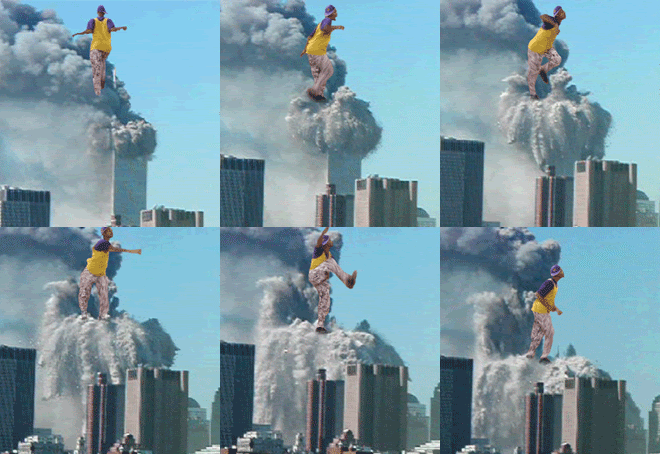
Groups 3-4, Journalism After 9/11
In the forward and introduction of Journalism After 9/11 by Barbie Zelizer and Stuart Allan, was in my opinion not an overly important topic. This entire article asked is whether journalist, news reporters and the like should have any right to report on 9/11 like they did, because many felt that there was too much propaganda and tabloid articles surfacing, that it was almost making a mockery out of 9/11. The authors also talk about how many of the news anchors from the well known even news channels like NBC, ABC, and CBS were harassed and were written about as having either no right to talk about 9/11, or report they way they do. The article is long and drawn out, I felt it was a waste of time, because I feel that the people reporting on 9/11, either right after the event or later on have every right to say and broadcast the news however they like, its their job!
One passage that is quoted and makes a lot of sense states that “the images were terrifying to watch, yet the coverage was strangely reassuring because it existed with such immediacy, even when detailed information was scarce. Imagine how much worse the nightmare would have been if broadcasting had been destroyed. On a day of death, television was a lifeline to what was happening” (Quoted in Journalism After 9/11). Of course there will be articles out there that are so flamboyant and over done, and sometimes not even reporting the truth, that’s why it is out job as citizens to pick and choose the material we want to read, from which sources we feel are credible, and be educated about the information being distributed, that’s what we have been learning in college for some odd years!
Besides, all of us who didn’t see it first hand, but watched it on TV, were deffinetly glued to out TV’s while the reporters did the best they could to either figure out what was going on or how to get the best coverage of the event, because we all wanted to see more. One Fox News vice presedent who was quoted saying “‘I think at first out audience and all the television news were like moths to the [screen]…We are addicted to the video of the horrific event’” (Quoted in Journalism After 9/11). Without the news coverage, we all would have been either left with our radios or completely in the dark, the news will always be the news, cause we want to know, we are a nation that thrives on information, being in the know.
Alicia
One passage that is quoted and makes a lot of sense states that “the images were terrifying to watch, yet the coverage was strangely reassuring because it existed with such immediacy, even when detailed information was scarce. Imagine how much worse the nightmare would have been if broadcasting had been destroyed. On a day of death, television was a lifeline to what was happening” (Quoted in Journalism After 9/11). Of course there will be articles out there that are so flamboyant and over done, and sometimes not even reporting the truth, that’s why it is out job as citizens to pick and choose the material we want to read, from which sources we feel are credible, and be educated about the information being distributed, that’s what we have been learning in college for some odd years!
Besides, all of us who didn’t see it first hand, but watched it on TV, were deffinetly glued to out TV’s while the reporters did the best they could to either figure out what was going on or how to get the best coverage of the event, because we all wanted to see more. One Fox News vice presedent who was quoted saying “‘I think at first out audience and all the television news were like moths to the [screen]…We are addicted to the video of the horrific event’” (Quoted in Journalism After 9/11). Without the news coverage, we all would have been either left with our radios or completely in the dark, the news will always be the news, cause we want to know, we are a nation that thrives on information, being in the know.
Alicia
Another Tape Ties bin Laden To Hijackings
Tuesday, June 3, 2008
A NATION CHALLENGED: THE EVIDENCE; Another Tape Ties bin Laden To Hijackings
By DAVID E. SANGER
Published: December 10, 2001
A tape of Osama bin Laden found recently in Afghanistan shows him recounting how he listened to news reports on the radio of the first plane crashing into the World Trade Center three months ago and quickly told others around him ''there will be more'' as he awaited the second attack.
Administration officials say they have read transcripts of the amateur videotape, which the White House is debating whether to make public, and that Mr. bin Laden seemed amused that many of the hijackers in the attacks apparently had not known they were on suicide missions.
''He suggests that they just thought they were involved in a conventional hijacking,'' one administration official said today.
''There is a lot of laughter on the tape,'' he added. ''What's new is the notion that some of the hijackers didn't know they were going to die.''
In fact, federal investigators have theorized for some time that the hijacking teams were divided into two distinct groups: one or two leaders on each plane who understood the mission and served as pilots, and assistants who were recruited to control the crew and passengers, but probably had no knowledge of the true goal.
American military forces or Central Intelligence Agency personnel working in Jalalabad discovered the tape, officials said, and its existence was first reported in The Washington Post this morning. President Bush has been briefed on its highlights, and today Vice President Dick Cheney and the chairman of the Joint Chiefs of Staff, Gen. Richard B. Myers, said they had read excerpts, translated from the Arabic.
But within the administration, a debate has broken out over the wisdom of making the tape public. Many in the White House argue that it will bolster the case to the Arab world that Mr. bin Laden planned the attacks and portray him as so cold-blooded that his own followers did not know their mission would result in their certain death.
Others, however, are arguing that many in the Arab world would find the discovery of the tape too convenient and charge that it was a creation of the C.I.A. and Hollywood collaborators. ''The quality is not good, the images are dark, and it would open us up to charges that we fabricated it,'' one senior official said today.
In an interview this morning on the CBS News program ''Face the Nation,'' Mr. Cheney called the tape ''one more piece of evidence confirming his responsibility for what happened on 9/11.''
But, perhaps reflecting the internal arguments within the administration about the wisdom of releasing the tape, Mr. Cheney added, ''We've not been eager to give the guy any extra television time'' and said he would ''rely on the experts as to whether or not it would be a good idea for us to release'' the video, or a transcript.
The tape in question is the second that the administration has discovered and kept to itself. The Arab television network Al Jazeera received the first of these tapes of Mr. bin Laden more than a month ago. In it, he offered extreme denunciations of the United States. But Al Jazeera decided not to broadcast it, administration officials said.
It is unclear why the network made that decision, but Al Jazeera had been sharply criticized in the West for broadcasting an earlier tape of Mr. bin Laden hours after the American bombing of Afghanistan began. The Bush administration obtained a copy of that tape, officials said, but chose not to make it public.
But in that first tape, Mr. bin Laden said nothing that would confirm he had prior knowledge of the Sept. 11 attacks, according to an administration official who has reviewed it. The latest video, obtained in Afghanistan two weeks ago, records a much more informal talk, apparently at a dinner with his supporters.
The date of the recording is not clear, officials say, although the C.I.A. has told the White House that it believes that the tape is authentic.
During the dinner talk, Mr. bin Laden recounts how he had the radio on in the hours before the terrorist attacks, apparently expecting word of the crash. ''He knew when it was going to happen and tuned in,'' said one American official who has read the translation, ''or so he said. He was saying to people around him, 'Wait, there will be more,' or words to that effect.''
· 1
Just something stupid that relates to discussions we've had:
http://www.hulu.com/watch/11444/family-guy-lois-sways-idiot-undecideds
-Mike Torem-
aka the big guy with red hair that sits near the wall.
http://www.hulu.com/watch/11444/family-guy-lois-sways-idiot-undecideds
-Mike Torem-
aka the big guy with red hair that sits near the wall.
Monday, June 2, 2008
Links to articles from 6/2
Here are the links to the articles we discussed today:
"Hijacked Jets Destroy Twin Towers and Hit Pentagon" by Serge Schmemann, The New York Times, Sept. 12, 2001
"Terrorists Hijack 4 Airliners, Destroy World Trade Center, Hit Pentagon; Hundreds Dead: Bush Promises Retribution; Military Put on Highest Alert" by Michael Grunwald, Washington Post, Sept. 12, 2001
"If You Want to Humble an Empire" by Nancy Gibbs, Time Magazine, Sept. 14, 2001
"The Waking Nightmare--and the Dawn of Life in Wartime" by Michael Wolff, New York Magazine, Sept. 17, 2001
"Hijacked Jets Destroy Twin Towers and Hit Pentagon" by Serge Schmemann, The New York Times, Sept. 12, 2001
"Terrorists Hijack 4 Airliners, Destroy World Trade Center, Hit Pentagon; Hundreds Dead: Bush Promises Retribution; Military Put on Highest Alert" by Michael Grunwald, Washington Post, Sept. 12, 2001
"If You Want to Humble an Empire" by Nancy Gibbs, Time Magazine, Sept. 14, 2001
"The Waking Nightmare--and the Dawn of Life in Wartime" by Michael Wolff, New York Magazine, Sept. 17, 2001
Subscribe to:
Posts (Atom)